Felicity Wanless
The CageFelicity Wanless is an early captive of The Phantom, and her story exposes the logic by which he treats women as replaceable possessions. She plans an escape, fails to get free, and is later killed when The Phantom selects Jill Richards as her replacement. Felicity’s experience also shapes Jill’s understanding of the danger she faces, while the objects taken from Felicity after her death eventually help connect the killer to his crimes.
Captivity and the Attempt to Escape
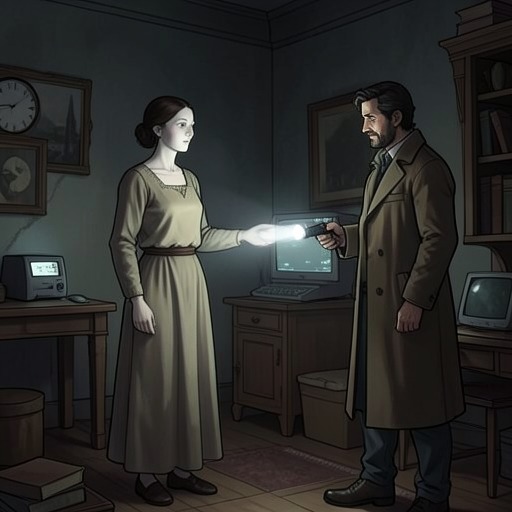
By the time Felicity appears in the loft, she is already imprisoned in a cage beneath a floor hatch. Her captor reaches her by lowering an extending ladder, and the routine of his visits governs when she can move outside the cage. The ropes around her wrists and ankles, the locked door, and the confined loft establish the practical limits of her captivity: even brief movement depends on the man’s permission. The scene presents her waiting for his arrival, alert to ordinary signs of his presence in the house, including the heating coming on below.
Felicity does not accept captivity as inevitable. She spends a day preparing to resist, drawing on the memory of a judo class she attended when younger. When her captor directs her toward the bedroom, she attacks and briefly knocks him off balance. She takes the rope he has dropped and runs down the stairs, aiming for the kitchen and the back door. Finding the door locked, she searches for a key and then tries to use a pan to break a window. The attempt ends when her captor catches up with her and overpowers her. The sequence shows both her planning and the limits imposed by the house: she reaches the route she associates with freedom but cannot get through the locked exit before he regains control.
The failed escape has consequences beyond that immediate struggle. Later, Jill Richards understands from what Felicity told her that the attempt made The Phantom more cautious. Jill also tries to resist and concludes that her own effort has injured her and increased his anger. Felicity’s escape therefore becomes part of the knowledge Jill uses to assess the danger, even though it cannot provide a reliable method of getting out.
Replacement and Her Connection with Jill Richards
Felicity recognizes the pattern of captivity when a young woman is brought into the loft. She understands from the newcomer’s fear and condition that the woman has undergone the same process of control that preceded Felicity’s own confinement. The Phantom makes the change explicit: he tells Felicity that she has been replaced and that he has a new doll. His words make clear that, in his system, the arrival of another captive marks the end of the previous woman’s usefulness to him.
The new captive is Jill Richards. Felicity responds to her not as a rival but as someone who has entered the same frightening situation. She gives Jill a small, encouraging smile, and later whispers that Jill should be brave. That gesture is modest beside the power The Phantom holds over both women, but it creates a moment of recognition between them: Felicity sees Jill’s fear because she remembers her own first arrival. Her concern for Jill also contrasts with the captor’s language of replacement, which reduces each woman to a position another can occupy.
Felicity’s place in Jill’s recollections remains significant after she is no longer present. Jill remembers the thud she heard and infers that The Phantom had moved Felicity’s body to the loft hatch and pushed it out. The captor later tells Jill that he killed Felicity and speaks of having shown her who was in control. Jill understands that Felicity’s fate is not merely a threat: it has already happened, and the same replacement rule now places Jill in danger.
Death and the Evidence Left Behind
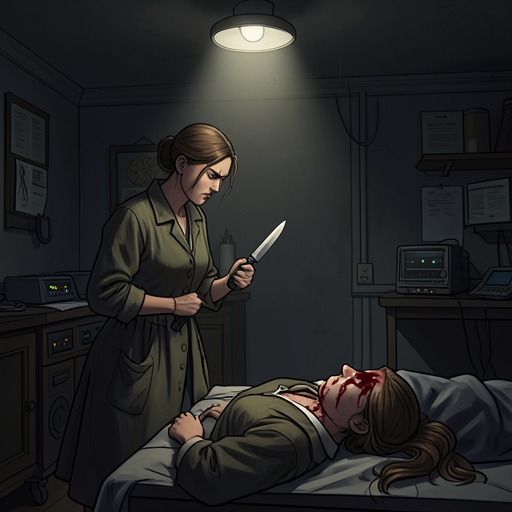
The Phantom kills Felicity on a Saturday. Jill later tells Zoe Hardy that she saw him kill Felicity by choking her with his bare hands, then remove one of her fingers and the tattoo from her skin. Felicity’s body is dumped in Roker on Sunday morning. These details establish the sequence from captivity to murder and disposal, while showing that the violence does not end with her death: The Phantom preserves what he has taken as part of a private collection.
The collection is handled methodically. The finger is placed in a vial of formalin bearing a narrow label with Felicity’s name and the date of her death. The tattoo is also kept for preservation. When investigators later search the house, Eve Strong finds the tattoo beneath the top drawer: a patch of skin inked with a small, happy penguin, pinned to plywood. The incongruity of the cheerful image and the way it has been retained makes the item an especially identifiable link to Felicity. For Eve Strong and Paul Forrester, it is part of the material evidence that The Phantom will have difficulty explaining away.
Felicity’s death thus has two consequences within the investigation. It confirms the danger attached to the captor’s replacement cycle, and the objects he keeps connect his treatment of individual victims to a wider pattern of trophies and mementos. What he regards as possession becomes evidence. Felicity herself cannot return to explain what happened, but Jill’s account and the preserved tattoo help make her fate legible to the people investigating the crimes.
Public Attention and Narrative Significance
Felicity’s story sits within an investigation where the public meaning of missing women is contested. When the disappearance of Terri Briggs and Berri Briggs becomes news, a newspaper speculates about whether the twins were taken by the same man, involved in a grooming gang, or simply ran away. Its portrayal of them is unflattering, and the article foregrounds a photograph of their mother, Linda Briggs, as well as the family home. Linda later complains that the press gives more attention to women who are pretty or have money, while working-class families like hers receive less concern. Her criticism makes visible the unequal recognition given to victims and their families, even as police struggle with numerous reported sightings.
In response, Linda Briggs, neighbors, and the twins’ friends organize a collection to print shirts using a photograph of Terri Briggs and Berri Briggs and a request for information. Iris says they will also send one to the newspaper, demanding that the missing girls be treated as important as The Phantom and his victims. This campaign does not change Felicity’s fate, but it sharpens the contrast between the killer’s private reduction of women to interchangeable dolls and the efforts of families and communities to keep missing individuals publicly recognizable.
Felicity is therefore more than the first woman whose captivity illustrates The Phantom’s method. Her attempted escape reveals both her resourcefulness and the captor’s control; her brief kindness gives Jill Richards a human connection inside the loft; and the remains of her tattoo help turn a concealed crime into investigable evidence. The movement from her identity as a missing woman, to the captor’s discarded victim, to a person identified through Jill’s testimony and the penguin tattoo gives her role a stark progression: The Phantom tries to erase the person while preserving fragments, and those fragments help expose him.